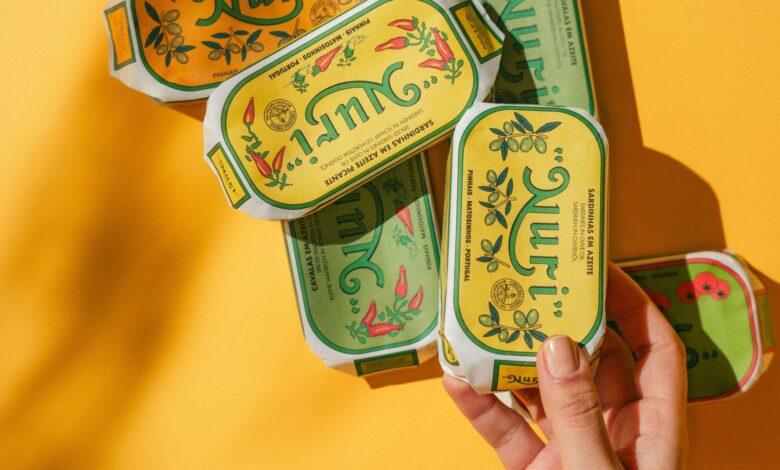

In Matosinhos, just north of Porto, there used to be dozens of sardine canneries. According to the Portuguese business news site ECO, the southern part of town alone had 54 around the Second World War. Today Conservas Pinhais & Cia is one of only two left there. Its survival came from a decision that looked commercially reckless at the time: it refused to automate. More than a century after it was founded, nearly every sardine that goes into its yellow-wrapped Nuri tins is still cut, packed and wrapped by hand. Demand for those tins is now growing faster than the old factory can supply them.
A refusal that became a business model
Pinhais was founded in 1920 by four partners. ECO names brothers Manuel and António Pinhal among them. The Nuri brand, which was created for export, was first registered in 1935. When the wartime boom pushed the canning industry to mechanise, António Pinhal Júnior refused. He was the founder’s son and led the company for 70 years. “If we had mechanised, we would not have been able to survive,” marketing director Patrícia Sousa told ECO in 2020. She explained that many canners took on bank debt to industrialise and then went bankrupt when demand fell again.
Staying with handwork kept Pinhais going through the decades, but it did not protect the company from the sardine shortage of the mid-2010s. According to Austria’s Kurier, Portugal and Spain cut sardine catch quotas by about 80% over several years because stocks had been overfished. In 2015, no Nuri products could be delivered to Austria at all. The next year the cannery was sold to Glatz GmbH, a Vienna family business that had been its exclusive Austrian importer for decades. ECO reports that the sale had one condition: the artisanal process had to stay. “We started again from zero and certainly needed one to two years to rebuild an economic basis,” Jakob Glatz, the fourth generation to lead the family firm, told Kurier.
Around 40 steps for one tin
The fish is bought fresh every morning at the auction at Matosinhos fish market, which the company says is about 1 km from the factory. “Our company does not work with frozen fish,” buyer Emília Braga told ECO. She has bought fish for Pinhais for 28 years and says she buys nothing on days when the quality is not good enough. The company says it pays fishermen a fair price at auction. It buys purse-seine-caught fish and holds MSC, IFS, HACCP and FDA certifications.
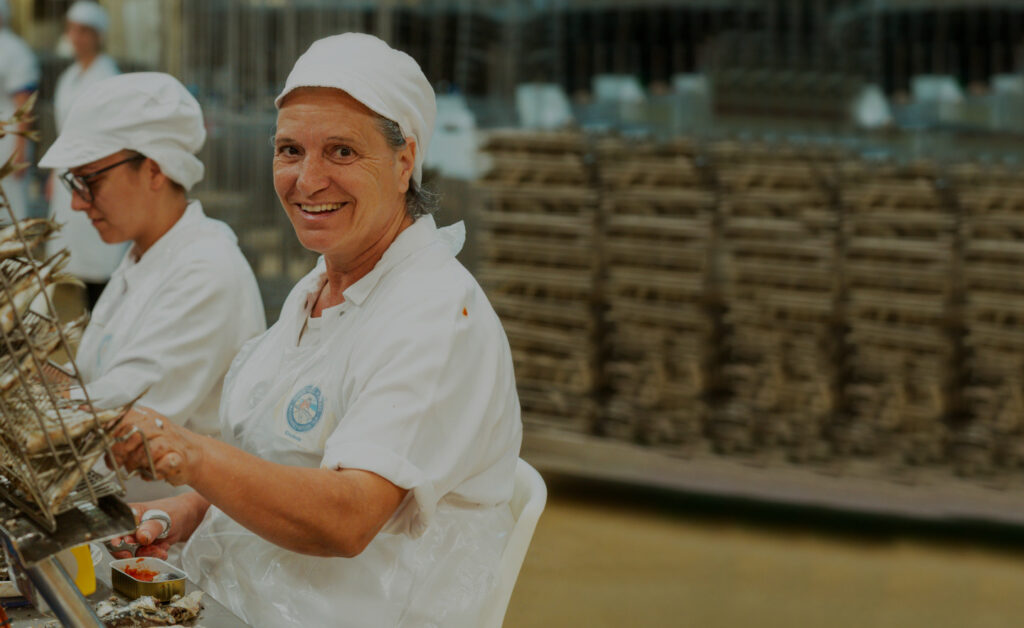
In the factory, the fish goes through what ECO counted as around 40 steps on stone benches that are a century old. The sardines are brined, cut, cooked individually by steam, and packed by hand with ingredients prepared fresh each day. Every tin then matures for about two months before it is sold. “Canned fish is like Port wine,” Sousa said. Output reflects the method. Pinhais makes 25,000 to 30,000 tins a day, while Sousa estimated that an industrial plant would make a million in the same time. The final step is hand-wrapping each Nuri tin in paper. ECO filmed Luzia Braga, who had worked at Pinhais for 34 years, wrapping about 300 tins an hour.
A focused range and a cult bestseller
The Nuri range is small. It includes 125 g sardines in olive oil or tomato sauce, plain or spiced, together with mackerel, sardine pâtés and an extra-spiced version. The bestseller is the spiced sardine in olive oil, packed with cucumber, carrot, piri-piri, laurel, clove and black pepper. Commercial director Nuno A. Rocha told PME Magazine in 2025 that this recipe has not changed since the 1930s. Newer products include sardines with hand-cut fresh Portuguese lemon and a Nuri Reserva matured for at least 36 months. The second brand, Pinhais, carries the company name and is aimed mainly at the domestic market.
Rocha also pointed to a strategy that matters to buyers: Pinhais does not produce for any other brands. That means no private label, selective distribution and full control over how the product is presented.
An exporter at heart
Exports are central to the business. Rocha told PME Magazine that 95% of production goes to more than 40 countries. In 2024, he told the credit insurer Crédito y Caución that the key markets were Austria, Germany, the UK and Denmark. He described the US as “consolidated and in clear expansion”, with newer business in Australia, Singapore, Macau and Hong Kong. Austria still accounts for about a third of Nuri tins, according to Glatz, but the US is now the fastest-growing market. “Consumption in the US is rising rapidly right now,” he told Kurier. “Fortunately we were in the market early enough.” A tin sells for about €4.50 in Austria and up to $8 at US delicatessens.
The company is still small. PME Magazine reported 140 employees and turnover of almost €6 million in 2024. Kurier puts Nuri’s annual sales at about €10 million, and says around 120 people work directly in production, almost all of them women.
Growth with the handbrake on
The opportunity is clear, and so is the constraint. Kurier reports that the cannery made just under three million tins a year for several years, about 4.5 million in 2025, and close to six million expected in 2026. Glatz wants to reach 12 million. However, the factory is a listed building and can only be expanded to a limited extent. Pinhais already cannot meet all demand: some deliveries have been pushed into the next year, and in some cases new customers are being turned away.

Pinhais is also under pressure on costs and competition. Glatz pointed to lower-cost producers in Morocco and Asia and to cheaper retailer own-label sardines. At the same time, overfishing is reducing catches in Morocco, which raises demand for, and prices of, Portuguese sardines. Rocha listed raw-material scarcity, climate change, and higher energy, transport and olive oil costs as the main challenges for the sector. Glatz is still not planning to automate. “We cannot win the battle for efficiency and cost leadership at our size,” he said. “That is why we focus on higher quality.”
The factory has also become a marketing asset. Since 2021, a working “living museum” tour has brought what Rocha calls thousands of visitors a year onto the production floor. For an industry that often competes on price per tin, Pinhais shows another route, also seen among small producers such as family wineries selling abroad: build the brand around the way the product is made, and sell it to the premium channels, from high-end food retail to specialist delis, that will pay for that story. Portugal’s food exporters, like the players in its expanding coffee industry, are increasingly using heritage as a selling point. Pinhais has relied on that approach since 1920.