

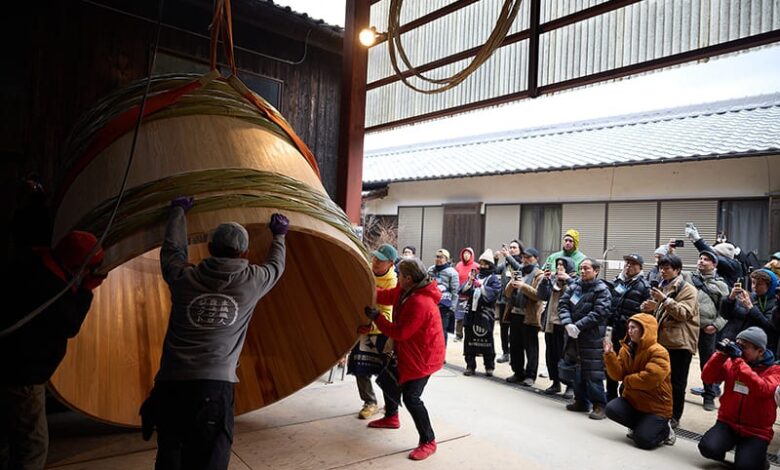

Soy sauce is one of the most standardised condiments in world food: brewed in stainless steel, shipped by the container and priced accordingly. On Shodoshima, an island in Japan’s Seto Inland Sea, a small family brewery has built an international reputation by doing the opposite. Yamaroku Shoyu makes all of its soy sauce in giant cedar barrels, ages its flagship for about four years, and has turned the survival of those barrels into a mission that now reaches well beyond its own business.
For food professionals, Yamaroku is an instructive case. It shows how a tiny producer in a commodity category can earn premium positioning, export distribution and global media attention, not by scaling up, but by protecting a production method almost everyone else abandoned.
A family business the father advised against
Yasuo Yamamoto is the fifth generation of his family to run the brewery. In a 2020 interview with the Japan National Tourism Organization, he described it as a roughly 150-year-old business, and told The Japan Times that the history isn’t clear, but according to his grandmother it goes back at least that far.
Taking over was not the plan. Yamamoto told the JNTO that his father advised him not to inherit the business, because it is hard to make a profit with the traditional method. He first worked as a sales rep at a local food company, where he saw how buyers pushed prices down even for additive-free products. His conclusion was to make something buyers would come and ask for, and barrel-brewed soy sauce from his family’s kura was his bet. His father died suddenly about two years after he returned, leaving him, in his words, to teach himself much of the craft.
Living barrels, living walls
Yamaroku ferments everything in kioke, cedar barrels of 3,000 to 6,000 litres, according to the company’s own description. Its moromi brewing house dates from the Meiji era and is a Registered Tangible Cultural Property. The brewery says its beams, earthen walls and floors are home to more than 100 varieties of yeast and lactic acid bacteria, and that crumbled wall is mixed with new mud and put back in its original place. Shodoshima’s warm, dry climate and the updraft from the Kankakei Gorge help the fermentation, the company says.
The scale of the operation is strikingly small. Yamamoto told the JNTO in 2020 that the company officially had just two people, with about seven part-time helpers. The Japan Times reported that he is solely responsible for manufacturing up to bottling preparation, while in soy sauce breweries one employee typically manages 10 to 20 barrels. Yamaroku has 90 barrels, up from 34 when he became president in 2001.
According to the Sustainable Japan coverage in The Japan Times (March 2026), kioke shōyu accounts for only about 1% of Japan’s soy sauce production, after the postwar shift to stainless steel and plastic tanks.
Tsuru-bishio: a soy sauce sold like a fine wine
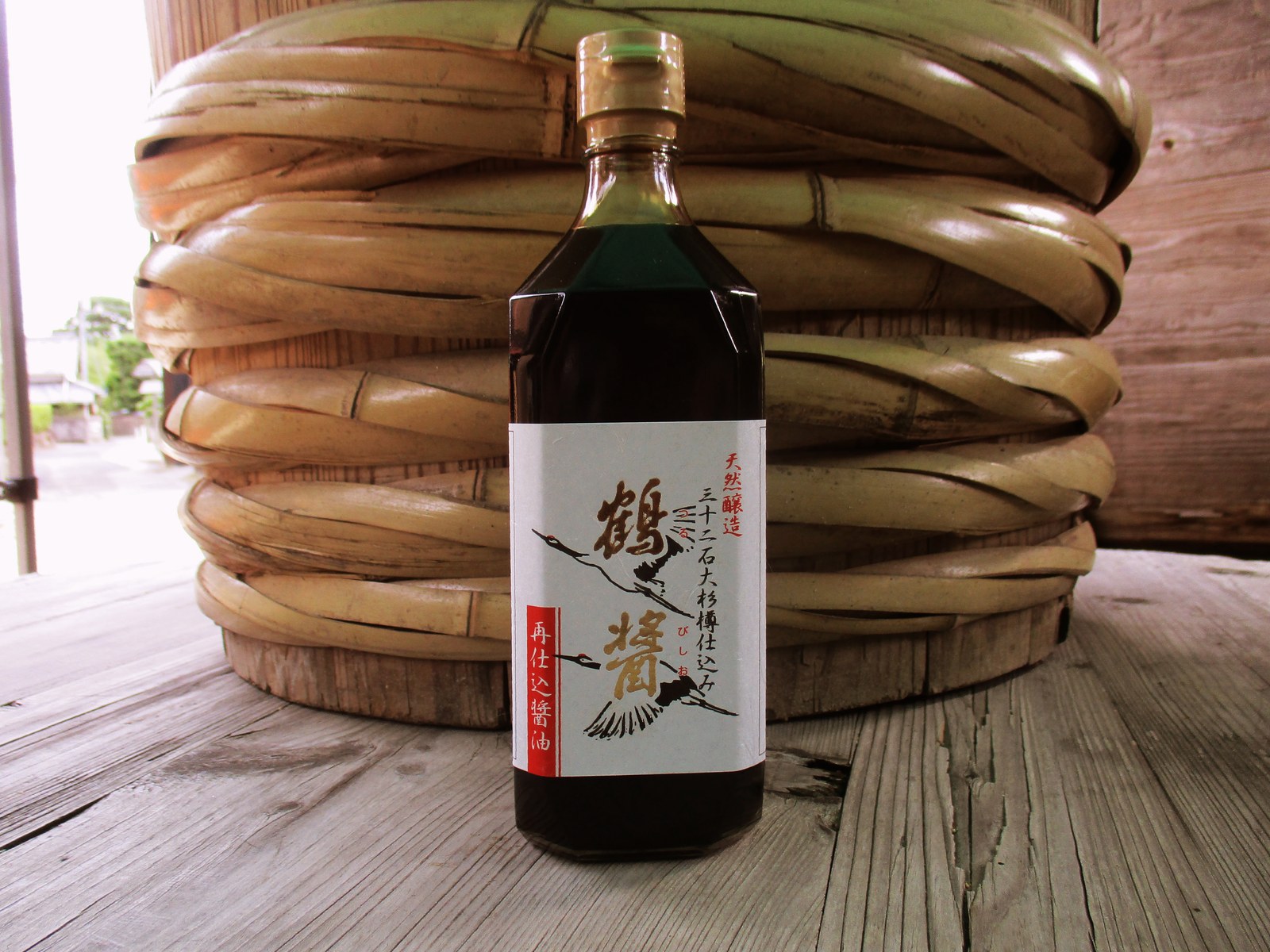
The flagship is Tsuru-bishio, a saishikomi or “re-brewed” soy sauce. Instead of brine, the brewery returns soy sauce aged one to two years to the barrel, adds fresh soybeans and wheat, and ages it for another two to three years, around four years in total. The company lists domestic Enrei soybeans, Hokkaido wheat and sun-dried salt from Mexico. It publishes a total nitrogen value, its measure of umami, of 2.3 or more for Tsuru-bishio, against 1.2 for regular light and 1.5 for regular dark soy sauce. The range also includes a citrus-rich ponzu and Kikutsuyu, a dashi soy sauce made with Rausu kelp and Makurazaki bonito flakes.
Yamamoto leans on wine language to sell it. He told the JNTO that Tsuru-bishio pairs with the same kind of food as red wine, such as meat or sashimi, and the 2026 Japan Times report says he positions kioke shōyu alongside wine and whisky as an artisanal aged product, rather than an industrial condiment.
The barrel crisis that became a business strategy
The turning point came in 2009. On the brewery’s account, Yamaroku took out as much credit as it could and ordered nine new kioke from the barrel maker, which said it was its first order for new soy sauce barrels since the Second World War. The master cooper warned that Yamamoto would have to repair his own barrels in the future, The Japan Times reported.
Yamamoto’s answer was the Kioke Craftsmen Revival Project, started in autumn 2011. In January 2012, together with carpenter friends from Shodoshima, he apprenticed with the barrel maker, and on 20 September 2013 the team finished its first barrels, built from Yoshino cedar from Nara Prefecture and hoops made of local bamboo. The company notes that the hoops have to be bamboo, because the salt would quickly corrode stainless steel.
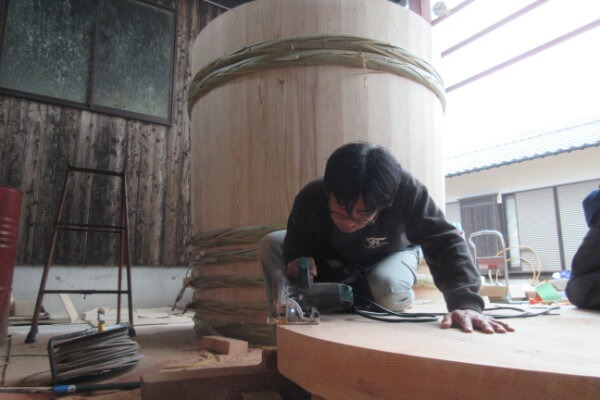
The media attention helped sales, but Yamamoto told The Japan Times in 2026 that if only his kioke soy sauce sold well, there still would not be enough work for coopers. So he chose to grow the category rather than his share of it. Every January the brewery hosts new barrel-building and the Kioke Fermentation Culture Summit, three days of barrel-making, lectures and business networking for soy sauce, miso and sake producers, restaurants and distributors. According to The Japan Times, a consortium of 28 companies now promotes kioke shōyu internationally, aiming to raise domestic production to 2% and reach a 1% presence in global markets. Yamaroku Shoyu received the Excellence Award in the satoyama category of The Japan Times’ Sustainable Japan Award 2025.
Export through specialist importers
Yamaroku’s importer list covers the United States (West Coast, East Coast and Hawaii), France, Germany, Sweden, Norway, the UK, Austria and Ukraine, as well as Hong Kong, Taiwan, Singapore and Vietnam. In the UK, the JNTO noted in 2020 that Tsuru-bishio was available at Japan House in London. The brewery itself has become a destination: Yamamoto told the JNTO that around 50,000 people a year visited, and the Japan Brand Collection reports that it is open to visitors without reservation and that coverage by outlets including CNN, BBC, Netflix and The Wall Street Journal has made it known abroad.
What the trade can take from it
Yamaroku’s model will not suit every producer, but its lessons travel. A heritage method can be a commercial asset if it is explained clearly, here with a wine-style vocabulary and measurable quality data. And a small company can build more value by organising its niche than by fighting over it. For buyers looking at premium Japanese pantry products, from matcha to fermented seasonings, it is a reminder that provenance stories hold up best when production is visible. Like Conservas Pinhais in Portugal and Rancho Gordo in California, Yamaroku shows how a small producer can win on craft rather than volume, a theme that also ran through the food trends at SIAL Paris 2026.


